Rights Under Attack in Northern Burma
An Overview of Human Rights Violations Perpetrated Between July and September 2026
Introduction
The human rights situation across Burma has continued to deteriorate rapidly amid escalating troop movements in local areas and communities. Armed with weapons, jet fighters have destroyed civilian livelihoods by attacking schools, farms, hospitals and communal areas, including places of temporary refuge such as internal displacement camps and shelters. Compulsory conscription has stolen young men and women from their families, forcing them to fight on the front lines. Thousands of political activists remain imprisoned and face systemic torture, while many others who are detained are dying from preventable causes because they are deliberately denied timely medical care.
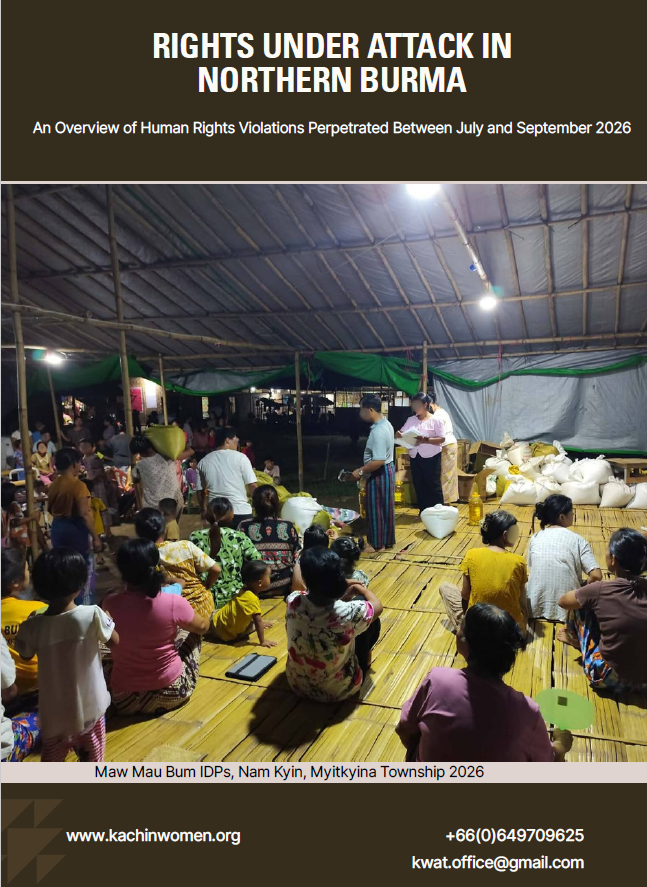
The Burma Army’s complete disregard for the sanctity of life has consistently proved to be evident in the scale and brutality of its attacks, which have included women, children and infants. Communities, particularly those in ethnic areas, are living in a constant state of survival and anxiety, unsure when the next attack will occur or whether they will be able to flee. The uncertainty has also created a displacement crisis that has left over 4 million people nationwide without reliable access to shelter, water and food, including at least 244,500 internally displaced people (IDPs) in Kachin State. Limited access to safe humanitarian aid has made conditions on the ground increasingly dire, with relief workers and assistance stalled due to the presence of soldiers, who target aid workers and delay the safe delivery of food and materials.
Of growing concern has been that the instability and increasing military presence in Kachin State, particularly in conflict-affected areas, have made it challenging to reach those directly impacted by the violence, especially in the aftermath of airstrikes and drone attacks. Debris and destitution have hardened the lived experiences of those who are constantly being bombarded by attacks.
According to the data documented by KWAT, evidence indicates that the Burma military has systematically dismantled democratic principles and institutions while committing widespread human rights violations against Kachin civilians. These violations have resulted in severe harm, suffering, and displacement among civilian communities. The collapse of the rule of law has further reduced and undermined justice pathways for survivors and victims of the violence. For women and girls, the impacts of the conflict are especially concerning, as they remain vulnerable not only to the brute force and effects of large-scale attacks and surveillance but also to conflict-related sexual violence, including rape as a weapon of war.
Of additional concern is the impact of natural resource extraction on civilians. The armed conflict and rare-earth element (REE) mining are closely interconnected and mutually reinforcing. Rather than being separate challenges, conflict, resource extraction, and environmental degradation form part of the same political and economic system that shapes power, insecurity, and civilian protection. In Kachin State, rare-earth extraction expanded rapidly from the mid-2010s, especially along the China–Myanmar border in Chipwi Township’s Pangwa region. Mining grew amid
fragmented governance, with control over land, labour, and trade routes shifting among militia-linked authorities, ethnic armed groups, and state and transnational actors. As a result, communities face both conflict-related insecurity and environmental harm.